

Extended
Historic Winchester
Tour
How to use this tour.
12345
If you are using the audio tour offline you can download the complete audio, Map and Transcript below, if not you can follow along with this page.
If you haven't yet parked, please see our recommended Car Parks for a Winchester day visit and make your way to 'The Butter cross'. This is our first stop for today's tour.
To navigate between the stops, use the maps provided on each step. You can use them online or download the PDFs if you wish to print or use them offline.
When you reach a stop, tap on the MP3 file to listen to the audio recorded for the stop. There will also be a transcript below. You can also tap 'Download' to save MP3s for offline use.
Follow the steps from 1 to 10 and play each and truly Discover Winchester.

Stops: 13
Distance: 3.21 km
Approximate time: 1 hour 45 mins
Heading 4
1. The Buttercross

Welcome to Winchester High Street. You’re now standing beside the Buttercross—this tall, ornately carved stone structure that has remained a completely immovable, utterly silent witness to daily life for more than six hundred years.
Built in the early 15th century, the Buttercross belongs to a tradition of market crosses—monuments that marked where trade was permitted and where a town’s everyday life naturally gathered. Winchester was still an important commercial centre at the time, and its markets were the lively core of the city. The Buttercross takes its name from the dairy traders who once sold butter, milk, and cheese around it, though in reality, merchants of every kind set up stalls here.
Markets in medieval Winchester were far from the orderly, tented affairs we’re familiar with today.
Think instead of organised chaos: heaps of produce, the occasional runaway chicken, traders competing for attention, and townsfolk bartering with theatrical enthusiasm. On second thought, perhaps it’s not so different from Winchester’s modern market after all! In any case, the Buttercross stood at the very centre of the commotion—an enduring stone anchor amid the bustle.
Take a moment to look closely at the monument. It’s far more intricate than it first appears. About halfway up each face stands a large carved figure, and above each of them, nestled into small niches, are two smaller statues. These eight upper figures represent the Virgin Mary and Saints Bartholomew, John, Lawrence, Maurice, Peter, Swithun, and Thomas. Of the four larger statues, only one—the figure of St John the Evangelist facing the shop—is original, dating back to the 15th century. The others were added during a major Victorian restoration in 1865, when architect Gilbert Scott introduced three new figures: William of Wykeham, Lawrence de Anne, one of Winchester’s early mayors, and King Alfred the Great. It’s as if the monument has gradually gathered its own distinguished guest list across the centuries.
Yet the Buttercross very nearly didn’t survive at all. In 1770 it was sold by the Paving Commissioners to a Mr Dummer, who planned to dismantle it and take it away to his own estate. The people of Winchester were having none of it. When removal day arrived, they gathered in force, surrounding the monument and firmly preventing its departure. Faced with such determined public resistance, the plan was abandoned, and the Buttercross remained exactly where you find it today.
Over time, this became a natural meeting place. It has witnessed public announcements, business deals, gossip, and countless people simply waiting for friends. Winchester College students even developed a habit of climbing it in the 17th and 18th centuries—a pastime eventually banned, proving that youthful mischief is timeless.
So as you stand here now, remember you’re not just looking at a medieval marker—you’re facing a monument the city quite literally fought to keep, one that has watched Winchester’s life unfold from century to century, right up until this day.
Transcript
2. The Westgate

Transcript
You’ve now arrived at Westgate, one of Winchester’s most impressive survivors from the city’s medieval defences. Standing here, beneath its great arch of flint and stone, you’re face-to-face with a structure that has watched centuries of travellers, traders, soldiers, and curious wanderers pass beneath it. In its long life, Westgate has been many things: a fortification, a toll point, and a prison.
The Westgate dates from the late 12th to 13th century, making it one of the oldest structures still in active use within the city. It formed the western entrance to Winchester when the city was surrounded by high stone walls. If you imagine those walls stretching off in either direction, you get a sense of just how formidable the city once was. Anyone approaching from the west—pilgrims, merchants, royal messengers—would have had to pass through this gateway, often under the watchful eyes of armed guards positioned above.
During the English Civil War in the mid-17th century, Westgate played its part in the siege of Winchester. Royalist forces held the city, and Parliamentary troops attacked from this side. Musket holes and battle scars have been found in the surrounding stonework—quiet reminders of a conflict that once shook the city.
From the 17th century onward, the Westgate also served as a toll point. Anyone bringing goods into the city would pay their due here, whether they were a tanner arriving with hides, a brewer with barrels of ale, or a farmer with a cart of apples. It was essentially Winchester’s medieval customs office, though considerably more picturesque than the modern equivalent.
Today, the traffic beneath it is a little calmer, and the gate no longer needs defending. But as you stand here, take a moment to imagine the centuries of footsteps that have echoed beneath this arch—the clatter of hooves, the rumble of carts, the shouts of guards, and the quiet scratch of a prisoner marking time. Westgate has seen all of it, and now it welcomes you as the next chapter in its long and extraordinary story.
3. The Great Hall
Transcript
Before you stands the Great Hall, one of the finest and most significant medieval halls to survive anywhere in England. Although today it appears almost self-contained, this building was once the ceremonial heart of Winchester Castle, a vast royal fortress that dominated the western approach to the city. The Great Hall is the last major piece of that complex still standing in its original form—and its stone exterior still carries the quiet authority of seven centuries of royal history.
Long before the Great Hall was built, Winchester had already risen to prominence under King Alfred the Great, who made the city his capital in the late 9th century. Although Alfred’s own royal complex stood on an earlier site nearby, his choice of Winchester as the political and cultural heart of his kingdom set the stage for everything that followed.
Winchester Castle itself was founded shortly after the Norman Conquest in 1067 and quickly became one of the most important strongholds in the Kingdom. For centuries, it served as a royal residence, a military base, and a centre of government. Kings such as Henry II and Henry III spent long periods here, holding court, administering justice, and consolidating their authority across the south of England. The castle’s sprawling compound once included royal chambers, chapels, gatehouses, and defensive towers, all arranged to display the power and prestige of the monarchy. At times, it also played host to great gatherings—assemblies, feasts, and judicial hearings—that underscored Winchester’s former status as a political heartland long before London rose to prominence.
Reconstruction of the hall began in 1222 under King Henry III, who invested heavily in strengthening and embellishing Winchester Castle eventually finishing in in 1235. The result is what you see now: a long, dignified structure of flint and stone with tall, elegant windows set high into its walls. If you look closely at the masonry, you can trace the building’s long life in its layers. The lower courses reveal the solid 13th-century work—thick walls designed as much for defence as for ceremony. Higher up, later repairs and restorations can be spotted in the change of stone colour and texture, including work from the Victorian period, when renewed interest in medieval architecture led to a number of careful restorations across the city.
One of the most famous features associated with the Great Hall is the so-called “Round Table,” often linked to the legends of King Arthur. Although the table hangs inside, its history affects the building’s story as a whole. The table itself dates to the late 13th century, and its Tudor paintwork—complete with a portrait of Arthur modelled suspiciously on Henry VIII—reflects the long tradition of using the hall as a symbol of royal legitimacy and ancient authority.
The castle that once surrounded the hall did not fare as well. Much of it was demolished in the mid-17th century after the English Civil War, when Parliamentary forces ordered the destruction of Royalist strongholds. The Great Hall survived, perhaps because of its structural strength, or perhaps because its civic value was already recognised. Whatever the reason, it continues to stand as a rare and impressive remnant of England’s medieval government.
The Great Hall has outlived kings, wars, and the fortress it once served—but its presence here still speaks of a time when Winchester stood at the centre of English power.
4. The Peninsula Barracks

Transcript
You’re now standing before the Peninsula Barracks, a broad sweep of commanding buildings that crown the high ground above Winchester. From here, the complex looks almost regal—its neat symmetry and dignified brick façades giving little hint of the military muscle it once represented. Yet for nearly two hundred years, this was one of the most important military sites in the south of England.
The story of Peninsula Barracks begins in the early 19th century, when Britain was emerging from the long and exhausting Napoleonic Wars. Between the 1790s and the 1820s, a major programme of military construction transformed this hilltop, replacing earlier, scattered structures with a proper barracks complex built to house regiments of infantry. The name “Peninsula” commemorates the Peninsular War, the campaign in Spain and Portugal that shaped the careers of many British officers who later passed through these gates.
Over the years, the barracks expanded and adapted. In the Victorian period, additional buildings appeared, reflecting shifting military needs and the continual presence of troops in Winchester. Regiments stationed here would have drilled on the parade ground, their commands echoing against the walls, while horses, carts, and later military vehicles rumbled through the gateways. Even today, you can almost imagine the soundscape: the clatter of boots, the calls of sergeants, the steady rhythms of military life.
Throughout the 19th and early 20th centuries, Peninsula Barracks became a hub for soldiers heading overseas. Troops bound for Ireland, India, South Africa, or the Western Front would have spent their final days on British soil preparing here—cleaning kit, writing last letters home, or staring out over Winchester’s rooftops before marching away.
By the late 20th century, the army no longer needed such extensive accommodation in the city, and much of the site was carefully redeveloped. Several buildings now house military museums, while others have found new civilian uses. Yet despite these changes, the overall feel of the place remains unmistakably martial. The broad arches, the commanding elevation, and the disciplined lines of the architecture still speak of centuries of service.
As you stand here, take in the scale of it—the sweep of buildings, the elevated position, and the sense of order built into every wall. Peninsula Barracks may no longer march to military commands, but its presence remains a powerful reminder of Winchester’s long and distinguished connection with Britain’s armed forces.
5. Winchester Cathedral
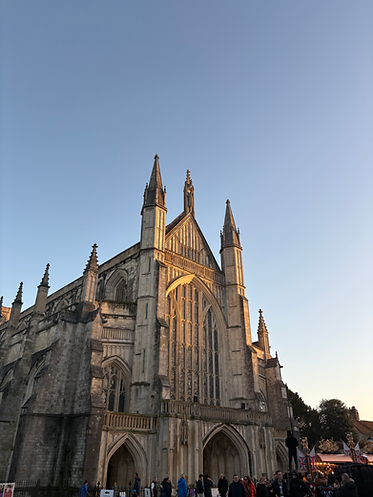
Transcript
Before you rises Winchester Cathedral, one of the largest and most historically significant medieval cathedrals in Europe. Its long, low silhouette and extraordinary length—169 metres from end to end—place it among the longest Gothic cathedrals in the world. What you see today is the result of over nine centuries of building, rebuilding, repairing, and sometimes downright rescuing.
The story begins in 1079, when Bishop Walkelin, William the Conqueror’s kinsman, ordered the construction of a vast new Norman cathedral to replace the earlier Old Minster nearby. By 1093, the monks processed into the new building, marking its official opening. The massive Norman transepts and crypt still survive beneath the later Gothic skin. If you walk around the exterior, especially the north and south transepts, you can still see the original 11th-century round-arched windows and thick masonry laid during Walkelin’s tenure.
The west front you’re facing, however, tells a later story. In the 14th century, Winchester embraced the fashionable Perpendicular Gothic style—tall windows, vertical lines, and broad expanses of traceried glass. The transformation began under Bishop William Edington and was carried forward by his successor Bishop William of Wykeham, founder of Winchester College. Much of the nave was remodelled between the 1350s and 1390s, essentially wrapping the Norman structure in a new Gothic façade.
The large west window, destroyed during the English Civil War in 1642, was pieced back together afterwards from surviving fragments like a giant stained-glass jigsaw puzzle. Its destruction was no accident: Parliamentarian soldiers, driven by strict Puritan beliefs, saw the cathedral’s stained glass as a form of Catholic decoration. When they stormed Winchester, they deliberately targeted the great window, shattering it with musket butts, stones, and whatever tools came to hand. The aim was not simple vandalism but a theological statement—an attempt to strip churches ofanything hinting of ornaments, saints, or symbolism. After the war, local people gathered the broken glass from the floor, carefully preserving every shard they could find. When the window was repaired in the 1660s, the glaziers had no surviving design to follow, so they set the fragments randomly into new leading. The result is what you see today: a shimmering mosaic of medieval pieces, a window that tells the story of its own destruction as much as the artistry of its original makers.
One of the cathedral’s most dramatic episodes took place far below your feet. By the early 20th century, waterlogged foundations—especially on the south side—were causing the Cathedral to subside dangerously. Between 1906 and 1911, the cathedral was saved by William Walker, a deep-sea diver who spent nearly six years working underwater to shore up the collapsing walls. Wearing full diving gear, he placed more than 25,000 bags of concrete, 900,000 bricks, and 115,000 concrete blocks beneath the structure. Without Walker’s work, engineers agree the cathedral would have been lost entirely. William walker is a true legend in Winchester History, if you were to go north into the city from here you would pass the ‘William Walker Pub’ that was of course named after him, and a reminder of his efforts to save the Great Cathedral.
The grounds around you are filled with history as well. Monarchs buried here include King Egbert (d. 839), often regarded as the first king to bring much of England under unified rule; his reign marked the rise of Wessex as the dominant Anglo-Saxon kingdom, with Winchester emerging as a political centre. King Canute (d. 1035), the Danish ruler who became king of England, Denmark, and Norway, was also laid to rest here. His reign brought stability after decades of Viking conflict, and Winchester served as one of his chief seats of power. William II—known as William Rufus (d. 1100), the son of William the Conqueror, was brought to the cathedral after his mysterious death in the New Forest, reportedly killed by an arrow under circumstances that have intrigued historians for centuries.
Although all three were originally buried elsewhere within the church, their bones were later gathered into the painted mortuary chests that sit above the choir screens today, moved during the Norman rebuilding of the cathedral.
The cathedral has also been the setting for major national events. In 1554, Mary I, daughter of Henry VIII and England’s first queen regnant, married Philip of Spain, heir to the vast Habsburg empire. Their wedding was a grand and highly political affair, intended to strengthen England’s alliance with Catholic Europe. Mary entered through this very west end in a procession arranged by Bishop Stephen Gardiner, her trusted advisor and one of the leading Catholic figures of the age. Philip arrived shortly before the ceremony, escorted with equal splendour, and together they stood before the high altar in what was then one of the most magnificent weddings Winchester had ever witnessed.
As you look at the exterior—the flying buttresses, the long sweep of the nave roof, the mixture of Norman and Gothic stonework—you’re seeing not a single building, but a timeline in architecture: Norman ambition, medieval refinement, Tudor upheaval, Civil War damage, Victorian repair, and early-20th-century rescue. Winchester Cathedral has been broken, altered, celebrated, threatened, and saved more than once—but it has never ceased to dominate the city’s skyline and ultimate beauty.
6. St Swithun-upon-Kingsgate Church

Transcript
You’re now standing before St Swithun-upon-Kingsgate, one of Winchester’s most unusual and quietly remarkable medieval churches. At first glance it seems almost tucked away, perched directly above the old Kingsgate arch as if it had grown out of the stonework itself. This rare arrangement—an active church built over a surviving medieval city gate—dates back nearly eight centuries.
The gate beneath your feet, Kingsgate, was one of the entrances into the medieval precinct of Winchester Cathedral. It was constructed in the 12th century, part of the fortified boundary that once controlled access to the cathedral close. The church above it appears in records from 1264, when it was described as already in existence. That makes St Swithun-upon-Kingsgate one of the earliest surviving examples of a gate church in England.
The dedication is to St Swithun, a 9th-century bishop of Winchester whose shrine in the cathedral became one of the most important pilgrimage sites in medieval England. His association with humility and local identity makes the intimacy of this small church particularly fitting. Feel free to enter the church by going up the steps on the right-hand of the gate. Look at the simple flint and rubble walls and the small, deeply splayed windows—classic features of 13th-century ecclesiastical architecture. Unlike the soaring Gothic of the cathedral, this building was designed for the clergy and lay workers attached to the cathedral precinct, not grand processions.
One of the most distinctive historical moments connected with Kingsgate came during the riot of 1264, when rebels supporting Simon de Montfort attacked royalist strongholds in the city. Records note that the church was damaged during this unrest, suggesting that even in the 13th century, its position above a gate made it vulnerable. The repairs you see today—particularly around the window stonework—reflect centuries of patching, strengthening, and patient care.
From the College and St Swithun’s street, you can also spot the later additions and alterations. The modest bellcote and some of the roof structure date from the 17th and 18th centuries, when the church continued to serve a small but committed parish. The worn steps leading up through Kingsgate, still used daily, preserve the sense of a lived threshold between the secular city and the cathedral precinct beyond.
St Swithun-upon-Kingsgate is often described as one of Winchester’s “hidden” churches, but in truth it has never been hidden at all. For over 750 years, every visitor passing beneath Kingsgate has walked directly under a functioning parish church—an architectural arrangement as surprising today as it must have been in the Middle Ages. Its survival speaks to the continuity of life in Winchester: quiet, resilient, unbroken, and firmly rooted in the city’s oldest stones.

7. Jane Austen’s Last Days House

Transcript
You’re standing outside 8 College Street, the unassuming house where Jane Austen, now regarded as one of the most important novelists in the English language, spent the final weeks of her life in 1817. The building is modest—plain brick, three storeys, simple sash windows—but its quiet appearance reflects the circumstances of Austen’s last months more than the cultural weight her name now carries.
Born in 1775 in Steventon, just 14 miles North from here, Austen wrote at a time when women’s voices were rarely given serious literary attention. Yet from that rural Hampshire rectory she produced works that reshaped the English novel. Her six completed novels—Sense and Sensibility, Pride and Prejudice, Mansfield Park, Emma, Northanger Abbey, and Persuasion—are celebrated for their sharp social observation, controlled irony, and intimate portrayal of everyday life. Though her settings were domestic and her scale modest, her insight into character and society was extraordinary; her work is now recognised as a bridge between 18th-century fiction and the more psychologically complex novels of the 19th century.
Austen came to this house in May 1817 with her sister Cassandra, seeking treatment from Dr. Giles Lyford at the County Hospital. Her illness—still debated by scholars—left her increasingly weak, but she continued to write and revise. Here she completed Persuasion and worked on the unfinished Sanditon, even as her strength faded.
The rooms she occupied were rented from Thomas Bull, a local baker. If you look toward the upper windows, you’re seeing the very spaces where Austen wrote letters, received visitors, and faced her final illness. She died here on 18 July 1817, aged 41, and was buried in Winchester Cathedral.
This quiet house is easily overlooked, but it stands at the intersection of ordinary life and extraordinary literary achievement—the final address of a writer whose influence continues worldwide.
8. Winchester College

Transcript
You’re now standing at the edge of Winchester College, founded in 1382 by William of Wykeham, Bishop of Winchester and twice Chancellor of England. It is the oldest continuously operating school in the country, and one of the first institutions in Europe to provide both education and full boarding under a single, planned system. Much of what you see today still follows Wykeham’s medieval blueprint.
Just ahead lies the Outer Court, with its distinctive flint walls and the great gatehouse completed in the late 14th century. Through that archway, generations of boys—known as Wykehamists—have passed, from medieval scholars in woollen gowns to modern pupils in their distinctive “div” dress. The college originally admitted seventy scholars, all supported by Wykeham’s endowment; many would go on to New College, Oxford, which he founded at the same time.
One of the most historic spaces is Chamber Court, the heart of the medieval school. Here you’ll find School, the original classroom, completed by around 1395. Inside, the timber roof still bears medieval carvings, and the blackened walls show centuries of candle soot left by generations of students studying long into winter evenings.
Nearby is the Chapel, consecrated in 1395, famous for its surviving medieval stained glass—some of the finest 14th-century glass in England. The windows depict prophets, angels, and apostles in luminous colour; many panels were carefully restored after the English Civil War, when Parliamentary forces smashed much of the chapel’s artwork. The glass you see now is a blend of original fragments and 19th-century conservation.
Winchester College has educated statesmen, poets, scientists, and reformers. Among its alumni are Henry Addington, Prime Minister; the poet Thomas Ken.
As you look across these courts and cloisters, you’re seeing an institution that has been teaching here—with remarkably little interruption—for more than six centuries. Its buildings aren’t just historic; they’re still in daily use, linking modern education with one of the great medieval foundations of England.

8. Wolvesey Castle
Transcript
You’re now in and amongst the ruins of Wolvesey Castle, once one of the most powerful ecclesiastical strongholds in England. These weathered stones may look quiet now, but for nearly a thousand years this site was the political engine room of the Bishops of Winchester—men who ranked just below the monarch in wealth and influence. The very name “Wolvesey” comes from Wulf’s Island, referring to the small area of raised ground formed by branches of the River Itchen.
The first palace at Wolvesey was built in the late 10th century for Bishop Æthelwold, already noted as grand enough for royal and ecclesiastical gatherings. Most of what survives today, however, comes from the 12th-century palace created by Henry of Blois (bishop 1129–1171), brother of King Stephen and a major political figure during The Anarchy.Henry transformed Wolvesey Castle into an impressive complex of halls, towers, and fortified walls. The East Hall hosted lavish feasts for kings and dignitaries, and chronicles praised the palace as “fit for princes.” Its defences proved real: in 1141, it withstood a major siege during The Anarchy, even as much of Winchester burned.
Wolvesey remained the bishops’ main residence for centuries, but by the 16th century it was outdated. During the Civil War, Parliamentary forces deliberately damaged it, and later scavenging stripped valuable materials, leaving the dramatic ruins seen today.
Yet Wolvesey’s story didn’t end there. In the 1680s, Bishop George Morley commissioned a new, elegant baroque residence—Wolvesey Castle (the “New Palace”)—a short distance to the south, designed by architect Sir Christopher Wren’s pupil Edward Pierce. This building is still used as the official residence of the Bishop of Winchester, meaning the site has maintained its ecclesiastical connection for over a millennium.
As you walk between these tumbled walls and archways, you are tracing the outlines of one of medieval England’s most influential power centres. Wolvesey may now be a ruin, but for centuries it was a place where national politics, royal drama, and church authority intertwined—its stones holding the echoes of kings and bishops who helped shape the course of English history.
9. The River Itchen

Transcript
Flowing quietly through the centre of Winchester, the River Itchen is one of England’s purest chalk streams an extremely rare habitat found in only a handful of places worldwide creating the river to appear clear. Its journey begins in the clear springs north of the city and winds south toward Southampton Water, but Winchester has always been its most historic crossing point. The Itchen was already a focal feature when the Romans built their settlement of Venta Belgarum here in the 1st century AD, and its clean, fast-moving water made the site ideal for mills, tanneries, and later medieval industry.
If you look at the river today—its clarity, its bright gravel bed—you’re seeing the same qualities that supported life for centuries. Medieval Winchester relied on the Itchen for drinking water, farming, and transport, and the city’s layout is still shaped by its channels and carriers. Several branches run through the centre, originally engineered to power fulling mills and grain mills; documentary records mention at least ten working mills in the Middle Ages.
The river also supported Winchester’s famous water meadows, developed in the 17th century. These carefully managed fields produced early spring grass for grazing, giving local farmers a significant advantage.
Tranquil as it looks, the Itchen is a living thread of the city—its history written as much in water as in stone.
10. Winchester City Mill
Transcript
Before you stands Winchester City Mill, a rare and remarkably long-lived survivor of England’s milling heritage. Perched directly over a fast, narrow branch of the River Itchen, the building you see today dates mainly from 1744, but milling on this site goes back more than a thousand years. The mill is mentioned in the Domesday Book of 1086, where it is recorded as one of several working mills that contributed income to the city’s ruling estates.
Its position wasn’t chosen for charm. This channel of the Itchen is naturally swift, and by narrowing it beneath the building, medieval engineers created a powerful flow capable of turning large undershot wheels. Grain from surrounding farms would be brought here to be ground into flour—a vital part of Winchester’s economy throughout the Middle Ages and well into the early modern period.
The 18th-century rebuilding gave the mill its current timber-framed form: brick at the lower levels, heavy beams above, and broad windows overlooking the water. Beneath your feet, the river still rushes beneath the millrace, echoing the constant roar that would once have filled this space. Historical records show that the mill continued commercial production into the 19th century, though competition from modern steam-powered mills eventually led to its decline.
In the 20th century, Winchester City Mill entered a new chapter. It was restored several times—first by local volunteers, and later under the stewardship of the National Trust, who took ownership in 1928. By the early 2000s, after major conservation work, the mill was once again fully operational, becoming the oldest working watermill in the country still producing stone-ground flour.
Today, it remains one of Winchester’s most atmospheric historic buildings. The City Mill is a reminder that the city’s story isn’t only told in castles and cathedrals—it’s also written in the steady turning of wheels, the labour of local people, and the enduring power of the River Itchen.
11. Winchester City Mill
Transcript
Before you stands Winchester City Mill, a rare and remarkably long-lived survivor of England’s milling heritage. Perched directly over a fast, narrow branch of the River Itchen, the building you see today dates mainly from 1744, but milling on this site goes back more than a thousand years. The mill is mentioned in the Domesday Book of 1086, where it is recorded as one of several working mills that contributed income to the city’s ruling estates.
Its position wasn’t chosen for charm. This channel of the Itchen is naturally swift, and by narrowing it beneath the building, medieval engineers created a powerful flow capable of turning large undershot wheels. Grain from surrounding farms would be brought here to be ground into flour—a vital part of Winchester’s economy throughout the Middle Ages and well into the early modern period.
The 18th-century rebuilding gave the mill its current timber-framed form: brick at the lower levels, heavy beams above, and broad windows overlooking the water. Beneath your feet, the river still rushes beneath the millrace, echoing the constant roar that would once have filled this space. Historical records show that the mill continued commercial production into the 19th century, though competition from modern steam-powered mills eventually led to its decline.
In the 20th century, Winchester City Mill entered a new chapter. It was restored several times—first by local volunteers, and later under the stewardship of the National Trust, who took ownership in 1928. By the early 2000s, after major conservation work, the mill was once again fully operational, becoming the oldest working watermill in the country still producing stone-ground flour.
Today, it remains one of Winchester’s most atmospheric historic buildings. The City Mill is a reminder that the city’s story isn’t only told in castles and cathedrals—it’s also written in the steady turning of wheels, the labour of local people, and the enduring power of the River Itchen.
12. King Alfred Statue
Transcript
Ahead of you is one of Winchester’s most recognisable landmarks: the statue of King Alfred the Great, unveiled in 1901 to mark the end of the Victorian era and the thousandth anniversary—according to Victorian calculations—of Alfred’s accession. Sculpted by Hamo Thornycroft, one of the leading artists of the New Sculpture movement, it presents Alfred not as a distant medieval figure, but as a commanding national hero.
Alfred ruled from 871 to 899, and Winchester served as the capital of his kingdom of Wessex. From here, he defended his realm against repeated Viking invasions, reorganised military service, established fortified towns—burhs—and implemented legal reforms that helped stabilise early English governance. He also championed learning, promoting translations of key Latin texts into Old English and encouraging literacy among his people. It’s these achievements that earned him the unique title “the Great,” the only English monarch to bear it.
The statue itself is deliberately theatrical. Alfred strides forward, sword raised high in his right hand—not in attack, but almost like a standard, a symbol of resolve. In his left, he grips a broad shield, planted firmly on the ground. Thornycroft designed the figure to appear taller than its already impressive nine feet, lifting it onto a substantial granite plinth carved from a single block. The effect is unmistakable: Alfred stands guard over the eastern approach to the historic city, just as he once defended the kingdom itself.
When it was unveiled on September 20th, 1901, thousands gathered along The Broadway. Winchester saw it not only as a tribute to a great king but as a statement of civic pride—a reminder of the city’s early political importance and its deep roots in the formation of England.
Today, the statue remains a popular meeting point and a defining feature of the cityscape. As you stand before it, you’re looking at more than bronze and granite; you’re looking at Winchester’s own monument to the moment when a struggling kingdom began to imagine itself as a nation.
12. The Guildhall
Transcript
Before you stands Winchester’s Guildhall, a confident sweep of Victorian civic pride completed in 1873. With its ornate Gothic Revival façade, pointed arches and tall clock tower, it was designed to make a statement—not of royal power, as many of Winchester’s older buildings once did, but of the growing importance of local government and public life in the 19th century.
The Guildhall was designed by Jeffery and Skiller, a Southampton-based architectural firm, and built on the site of an earlier 18th-century cloth hall. Its construction coincided with a period of rapid growth in Winchester, when the city was reorganising itself to meet modern needs: better public services, improved sanitation, and increasing civic responsibility. The new Guildhall symbolised that transformation. It housed the council chamber, the law courts, assembly rooms, and space for public events—a multifunctional hub for a newly confident municipal authority.
The clock tower, added a little later in 1893, gives the building its distinctive silhouette. Its statue of Queen Victoria, standing in a niche high above the street, was installed to commemorate her Golden Jubilee. She watches over the Broadway much as Alfred's statue does at the opposite end, creating a rather regal symmetry in Winchester’s townscape.
The exterior is full of detail: carved stone capitals decorated with foliage, traceried windows, and bands of Bath stone set into the darker flint. These touches were not just decorative—they were meant to assert Winchester’s long heritage while embracing modernity.
Over the years, the Guildhall has witnessed everything from election counts and wartime mobilisation meetings to dances, civic banquets, and local protests. During the First World War, parts of the building were used for military administration; during the Second, it served as an important centre for local civil defence. Even today, its halls remain busy with exhibitions, performances and gatherings—still fulfilling the purpose for which it was built.
As you take in the façade, imagine the countless footsteps that have passed through its doors: councillors, soldiers, clerks, campaigners, families attending celebrations, and townspeople seeking decisions that shaped the future of Winchester.